



How an Ellesanti piece is born: from choice to form

Many pieces of jewellery are born from a sketch, a trend, a new material to try. Here, the first note is often a sentence. Something a person is living through, or something she said while looking at a form: “This piece is me.”
We have heard it many times. People chose a piece of Ellesanti jewellery and recognised something of themselves in it, often before they even knew its story. From that sentence came a way of designing that starts from life and arrives at form, and sometimes travels the same path in reverse.
Here we follow it step by step: how an Ellesanti piece is born, from choice to form.
The starting point: an experience, not a style
Laura Santi, founder and designer of Ellesanti, spent twenty years listening to people for a living. She saw at close range the choices that change a life, the big ones and those nobody notices. Today that gaze works at the bench, in Padua.
The design starts there, from a passage of adult life: a choice, a bond, a boundary, an achievement. Design comes afterwards, and it has a precise task. It must find a form that can stand beside that passage.
From choice to form, in six steps
The Ellesanti method is a way of observing, designing and recognising. It can be described in six steps.
Experience. It starts from a moment of adult life. Starting again after a phase has come to a close, for example, or choosing yourself after years spent looking after others.
Choice. In that moment we look for the most important thing: the choice it contains. Without judging it. Those who start again often choose to keep what matters and add the new.
Formal logic. We look for a behaviour of form that can relate to that choice. A form continues, breaks off, joins, contains, opens. It is the most delicate step, because here the choice stops being an idea and becomes structure.
Material. The materials are chosen. They must last, because that meaning has to stay with the wearer for a long time, and they must be comfortable on the skin every day.
Jewellery. The piece is assembled by hand, one at a time, in the workshop in Padua.
Recognition. The person who chooses it recognises something of herself in it and completes its meaning. Sometimes she gives us back a reading we had not foreseen. From there, another form may be born.
The second way in: a form that already exists
We do not always start from an experience. Sometimes we start from a form, a material, a construction already made. We observe it for a long time and ask what it is really doing. The path is the same, in the opposite direction: experience can generate form, and form can reveal an experience.
What a form does
When designing an Ellesanti piece, we ask what a form does before we ask what it represents. A line continues without interruption. A knot holds. A geometry defines a limit. Several elements are added one to another. They are gestures of the material, observable by anyone.
These gestures return from one piece to another, with variations. We have gathered them into six lines, from I to VI: continuity, interruption, elastic tension that opens, geometric structure that marks out, verticality that descends, layering that adds. Repetition does not impoverish the language. It makes it recognisable.
Two examples, two directions
From experience to form: the Afrika+ necklace
The starting point is a question many people ask themselves at a new beginning: how can I start again without losing who I am? The choice it contains is clear. Keep what matters, add the new.
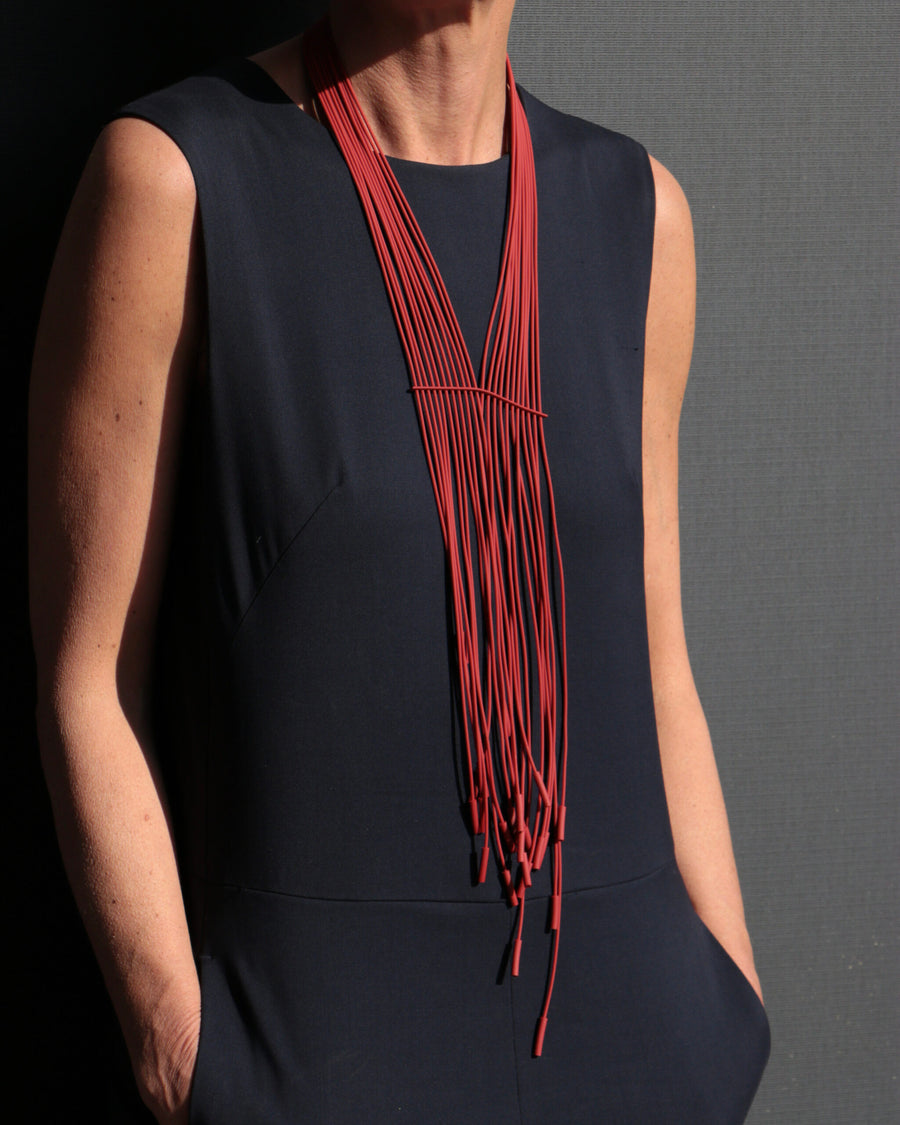
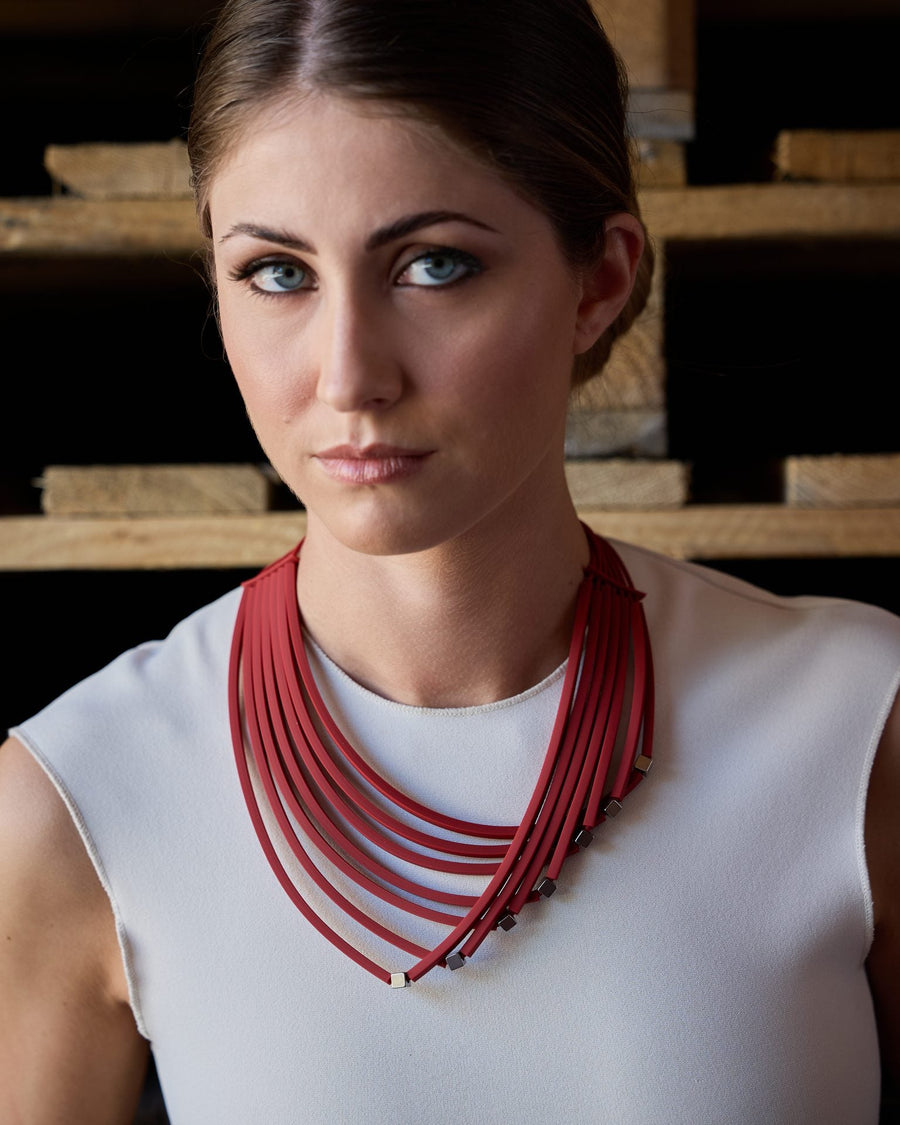
The Afrika+ necklace translates this choice into layers that coexist in the same space. Rhodium-plated brass cubes are added on rubber strands, and each element is added to those already there. The result is a form that makes visible a balance between what remains and what arrives.
From form to experience: the Vento earrings
In the Vento earrings, fine silver threads start out gathered and then open. They share a point, then take different directions. Here we started from the form, observing its behaviour.
In that gesture you can read an achievement that is not a conclusion, but a point from which other possibilities open. The sentence that accompanies it is this: “You have reached a point. From there, the space opens.” It is a suggested reading. Whoever wears them may find another.
Design, first of all
An Ellesanti piece must appeal to you even without an explanation. It must look good on someone who does not know the story of its form. The method works behind the scenes, with rigour. In front remains an object to wear every day: proportions, materials and details serve to make a meaning concrete, and at the same time to be comfortable from morning to evening.
This is why meaning is never imposed. A form does not define the person. It offers her a place in which to recognise herself.
Handmade in Padua, to order
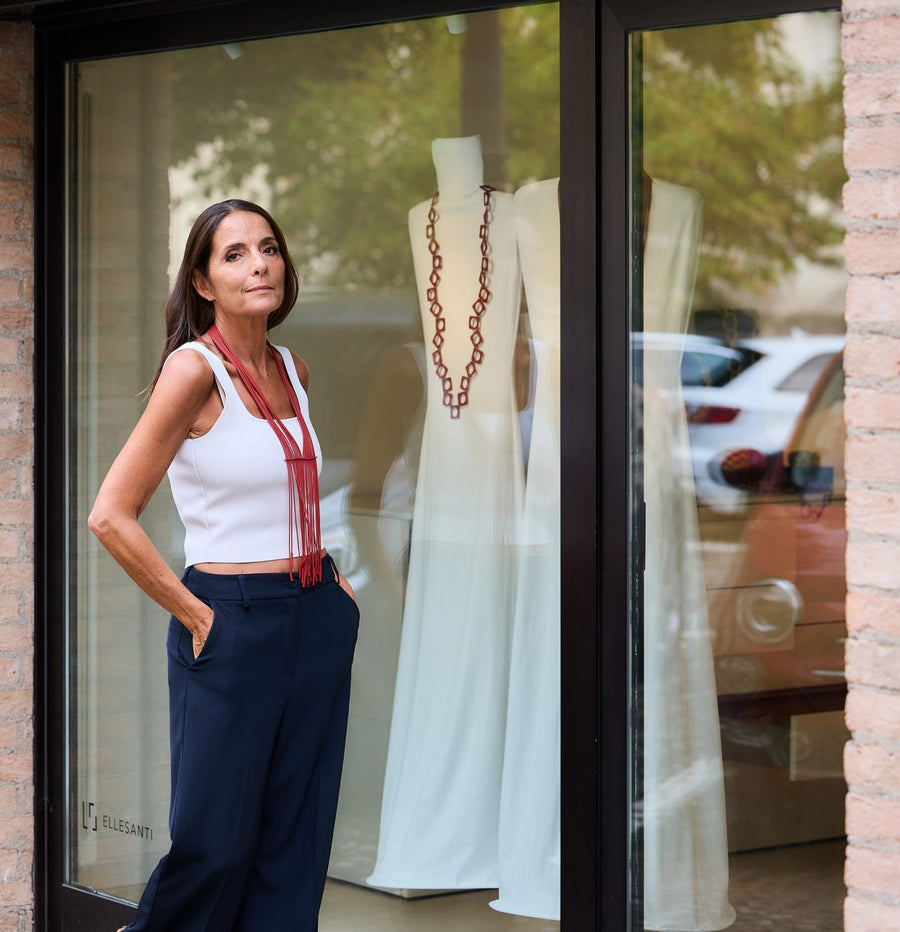
Laura designs the forms, chooses the materials and oversees production together with the artisans of the workshop. The workshop is in Padua, at Via XX Settembre 69, a few minutes’ walk from Prato della Valle. The workbench is in the window: passing by, you can see a piece taking shape.
Every piece is handmade to order. Work begins when you choose it and takes 3–5 working days. What you order online is born exactly there, in full view of passers-by.
The materials are designed to last: 925 sterling silver, rhodium-plated brass, Italian rubber. They are nickel-free and hypoallergenic, safe on the skin every day.
Meaning is completed by the person who chooses it
The path does not end when the piece is ready. It ends, or begins again, when someone chooses it and recognises something of herself in it. We build the sign. The person who wears it completes the meaning.
This, in the end, is what distinguishes a piece designed this way from an aesthetic exercise. The form is not born only to be looked at. It is born to stand beside a choice.
If you are in Padua, you can see the bench at work and try the jewellery in person: come and visit us at the Space. The method, in its complete form, is on the The method page.